
1.67 High-Index Lenses: Prescription Guide, Thickness & Trade-Offs
That distinction matters because 1.67 is often reduced to a simple prescription cutoff. Lensabl currently offers 1.67 as a thinner, lighter option for strong prescriptions, but the best material choice depends on the whole order—not one number on the prescription.
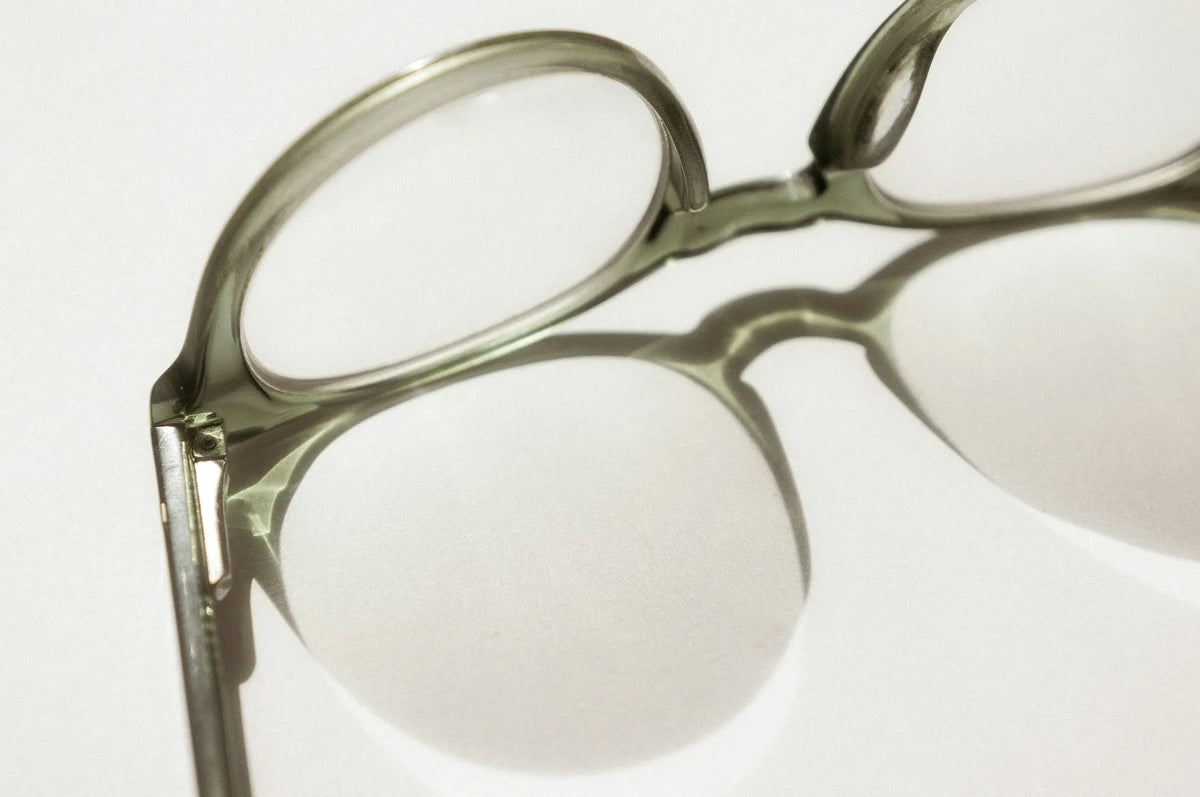
What Does 1.67 Mean in Glasses?
The 1.67 number is the lens material’s refractive index: a measure of how strongly the material bends light. In practical terms, a higher refractive index can achieve the same correction with a thinner lens profile than a lower-index material, all else being equal.
Lens index and prescription power are different things. A prescription contains values such as SPH and, when needed, CYL and Axis. Lensabl also uses measurements such as PD and OC to place the optics correctly in the frame. The index is the material choice used to make that prescription.
For a broader look at lens materials and refractive index, see Lensabl’s guide to different types of glasses lenses.
What Prescription Is 1.67 High Index For?
Lensabl places 1.67 in the strong-prescription category. Its current Lens Replacement configurator recommends 1.67 for strong prescriptions and describes the threshold as “a total power of +/-4 or greater.” Lensabl’s broader Our Lenses page separately says higher-index lenses are recommended for prescriptions stronger than +/-4.00 sphere.
Why 1.67 prescription “ranges” differ online
There is no single prescription band that every optical retailer uses for 1.67. Labs work with different lens designs, materials, frame rules, manufacturing limits, and product catalogs. That is why one retailer may recommend 1.67 at a different point than another.
Think of a range on a retailer’s site as that retailer’s product-selection rule. It is not a universal law that makes every prescription inside the range a 1.67 prescription—or every prescription outside it unsuitable.
Why SPH is not the whole prescription
SPH describes the main lens power for nearsightedness or farsightedness. CYL and Axis describe astigmatism correction when it is present. PD measures the distance between your pupils, and OC helps position the optical center vertically in the frame. These values do not all affect thickness in the same way, but together they show why lens selection should not be reduced to a single SPH number.
If you want a refresher on the fields in your prescription, use Lensabl’s Finding Your Measurements guide.
How Much Thinner Are 1.67 Lenses?
This is where “30% thinner” or similar internet claims can mislead. A percentage only makes sense when the baseline lens, prescription, design, frame, measurements, and material are controlled. Change the frame or the prescription geometry and the finished result changes too.
| Factor | Why it changes the finished lens |
|---|---|
| Full prescription | The amount and pattern of correction affect where thickness builds and how much material is needed. |
| Lens index / material | A higher refractive index can achieve the same correction with less material than a lower-index option, but the exact result is material- and design-specific. |
| Frame size and shape | A larger lens opening can leave more distance from the optical center to the lens edge, which can make edge thickness more visible in stronger minus prescriptions. |
| PD, OC and centration | Where your pupils sit within the frame affects how the lens is centered and how much lens area is needed around the optical zone. |
| Lens design | Aspheric, progressive and other designs can change lens geometry. Index alone does not describe the finished profile. |
| Frame mounting and lab requirements | Rimless, semi-rimless, wrap and other frame styles can require different material or production choices. |
Minus and plus prescriptions thicken in different places
With a minus prescription, the lens is usually thinner in the center and thicker toward the edges, so edge thickness is often the visible concern. With a plus prescription, thickness generally builds toward the center. That is one reason frame dimensions and pupil placement matter alongside the lens index.
Why Frame Size and Shape Matter
If you are replacing lenses in a frame you already own, the frame geometry is fixed before the lab starts. A strong prescription in a compact frame can finish very differently from the same prescription in a large frame because the lens has to cover a different area.
Lensabl’s own lens guide notes that frame size and shape influence thickness and that a smaller frame can help reduce lens thickness and weight for stronger prescriptions. For strong minus prescriptions in particular, a smaller lens opening can reduce how far the lens extends from the optical center to the outer edge.
Before ordering, check whether your current frame is supported using Lensabl’s Lens Replacement Eligibility guide. Lensabl says the vast majority of frame brands and styles are eligible, but it also lists specific exceptions and material restrictions for some frame types.
1.67 vs. 1.74 High-Index Lenses
The main technical difference is straightforward: 1.74 has a higher refractive index than 1.67. That can allow further thickness reduction for the same correction. It does not mean 1.74 is automatically the better lens for every person or frame.
| Comparison point | 1.67 high index | 1.74 high index |
|---|---|---|
| Refractive index | 1.67 | 1.74 |
| Lensabl positioning | A thinner, lighter option for strong prescriptions | Lensabl’s highest-index option, positioned for very strong prescriptions and maximum thinness |
| Potential thickness | Can reduce bulk compared with lower-index materials | May reduce thickness further than 1.67 for the same correction and comparable design |
| Is one always lighter? | No. Finished weight depends on both material properties and the amount of material in the completed lens. | No. A higher index does not by itself guarantee the lightest finished pair. |
| What should drive the choice? | Full prescription, frame, lens design, current Lensabl configuration, and your priority for thickness versus other material characteristics | The same factors, with extra emphasis on whether the stronger prescription/frame combination benefits from the higher index |
1.67 vs. 1.60, Polycarbonate, and Trivex
Lens materials are not a simple quality ladder. The right comparison depends on what you are trying to improve: lens bulk, impact resistance, optical performance, frame compatibility, or some combination of those priorities.
| Option | How it compares with 1.67 | What to keep in mind |
|---|---|---|
| 1.60 or another lower-index high-index material | Lower refractive index, so it may require more material for the same correction. | It can still be a sensible choice when the prescription and frame do not need the extra thickness reduction of 1.67. Availability varies by provider. |
| Polycarbonate | Lensabl positions it as an impact/shatter-resistant option for active lifestyles, children, and safety-oriented use. | Do not choose 1.67 purely because its index number is higher if impact resistance is the main requirement. |
| Trivex | Lensabl also positions Trivex around impact/shatter resistance and describes it as lighter than polycarbonate with greater optical clarity. | Its reason for being considered is different from the main 1.67 goal of reducing bulk in strong prescriptions. |
| 1.67 high index | Lensabl positions it around thinner, lighter lenses for strong prescriptions. | Finished thickness and comfort still depend on the full prescription, frame, design, and actual material. |
Trade-Offs to Understand Before Choosing 1.67
Index does not tell you everything about optical performance. Different 1.67 materials can have different optical and physical properties, so a specification from one manufacturer should not automatically be applied to another 1.67 lens.
Do not assume 1.67 is always the lightest option. A thinner lens can use less material, but finished weight also depends on the material itself and the shape of the completed lens.
Impact resistance is a separate decision from thinness. Lensabl specifically positions polycarbonate and Trivex for impact/shatter-resistant use cases.
Frame geometry can erase part of the benefit you expected from a higher index. A very large frame can still leave a strong prescription visibly thick even when the index is high.
What about Abbe value and color fringing?
Abbe value is one way the optical industry describes how much a lens material disperses light, which can relate to colored fringes in peripheral vision. For this guide, the key point is that Abbe value is material-specific. Lensabl does not publicly identify the exact supplier/material behind its current 1.67 option, so a number published for another manufacturer’s 1.67 material should not be presented as Lensabl’s specification.
If new lenses feel persistently distorted or uncomfortable, the cause cannot be diagnosed from the index number alone. Prescription accuracy, measurements, lens design, frame fit, and adaptation can all matter. Have the glasses checked by a qualified eye-care or dispensing professional.
How to Decide Whether 1.67 Makes Sense for Your Lensabl Order
1. Start with the complete prescription — Look at the full Rx, not just the SPH line. If you have CYL/Axis, ADD, prism, or other requirements, they are part of the lens design and ordering context.
2. Look at the frame you are keeping — Large lens openings, wrap shapes, rimless construction, and other frame details can affect both thickness and material eligibility.
3. Choose your priority — If reducing visible bulk in a strong prescription is the main goal, 1.67 is a logical option to compare. If impact resistance is the leading concern, compare Lensabl’s polycarbonate and Trivex options too. If the prescription is very strong, compare 1.74 rather than assuming 1.67 is the endpoint.
4. Use Lensabl’s current configurator for the final match — Product rules can change. Enter the full prescription and use the live ordering flow to see which options are currently available for your lens type and frame.
You can review the current high-index options on Our Lenses and then configure your order through Lens Replacement.
Frequently Asked Questions
Is 1.67 thinner than 1.60?
For the same correction and comparable lens design, 1.67 has a higher refractive index and can generally achieve the correction with less material than 1.60. The exact finished difference is not fixed because frame size, centration, design, and the specific materials still matter.
Is 1.74 always better than 1.67?
No. 1.74 has a higher refractive index and may reduce thickness further, but “higher” does not automatically mean better for every prescription, frame, or wearer. Compare the complete order rather than choosing the largest index number by default.
Can 1.67 lenses correct astigmatism?
Astigmatism does not automatically rule out 1.67. CYL and Axis are part of the full prescription. Lensabl publishes overall prescription capability on its Our Lenses page, but it does not publish a separate universal 1.67-specific CYL limit there. Use the current configurator with the complete Rx.
Does frame size affect high-index lens thickness?
Yes. Lens size and shape affect the finished lens geometry. With stronger minus prescriptions, a smaller lens opening can reduce the distance from the optical center to the edge and may help reduce visible edge thickness.
Can Lensabl replace the lenses in my current frames with 1.67?
Lensabl offers 1.67 high-index lenses through its lens replacement service, and it says the vast majority of frame brands and styles are eligible. Some frame types and material combinations have restrictions, so check the current eligibility guide and ordering flow before sending your frames.
Do 1.67 lenses cause distortion?
The index number alone does not explain visual distortion. Prescription accuracy, lens design, measurements, frame fit, material characteristics, and adaptation can all contribute. Persistent discomfort should be checked by a qualified eye-care or dispensing professional rather than diagnosed from the lens index alone.