
Bifocal vs Progressive Lenses: Differences, Cost and Adaptation
Both correct more than one viewing distance, but they do it differently. Here is how the lens zones, computer vision, cost, fitting measurements and adjustment period compare.

Bifocal vs Progressive Lenses at a Glance
| Feature | Traditional bifocal | Progressive lens |
|---|---|---|
| Viewing zones | Distance + near | Distance + intermediate + near |
| Visible line | Yes, on a traditional lined bifocal | No visible bifocal line |
| Computer / dashboard range | No dedicated intermediate zone | Built-in intermediate range |
| Peripheral feel | More abrupt change at the segment line | Peripheral blur or distortion can occur, especially at first |
| Adaptation | Still requires getting used to the segment change | Often requires learning where to look through the lens; timing varies by person |
| Typical relative cost | Often lower | Often higher than bifocals |
| May appeal to someone who… | Prioritizes simple distance/near zones and does not mind a visible line | Wants one no-line lens for distance, intermediate and near tasks |
The right choice is not a universal winner. It depends on what distances you need most during the day, how you feel about a visible line, your prescription and fitting, and how much of an adjustment period you are comfortable with. Cleveland Clinic’s progressive-lens overview and Ohio State Health’s comparison describe the same core trade-off: bifocals provide defined near and distance zones, while progressives add a gradual intermediate range.
What Are Bifocal Lenses?
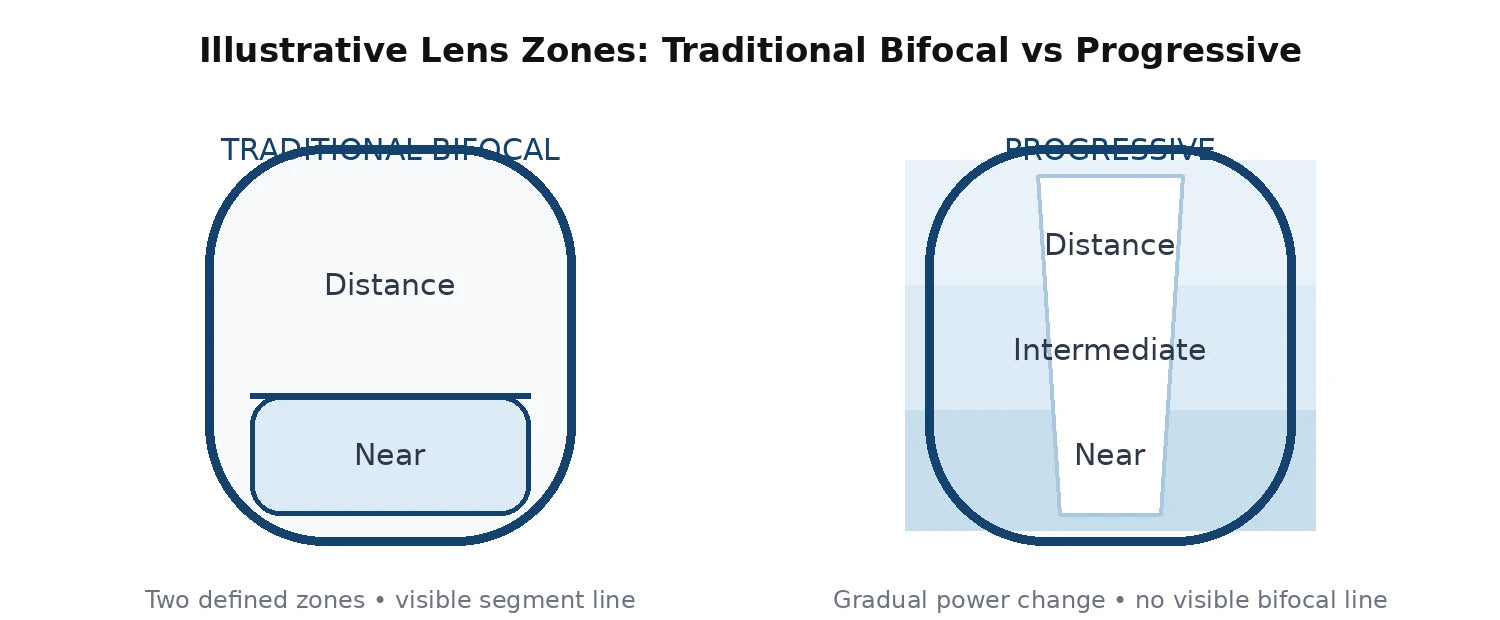
A traditional bifocal combines two prescriptions in one lens. The upper portion is generally used for distance vision, while a distinct lower segment is used for near work such as reading. The segment creates the familiar visible line that separates the two powers. Ohio State Health notes that traditional bifocals correct far distance and close reading but do not provide a dedicated computer/dashboard zone.
How the two viewing zones work
Instead of moving gradually through several powers, a traditional lined bifocal switches from the distance prescription to the near prescription at the segment line. That direct change can be useful when the main goal is clear far vision plus a defined reading zone.
What the design means in daily use
For a reader whose day is mostly distance viewing and close reading, the two-zone layout may feel straightforward. The compromise shows up at arm’s-length tasks: a desktop monitor, dashboard, sheet music stand or kitchen counter often sits between classic distance and reading ranges. Depending on the prescription and working distance, that may make an intermediate task less convenient than it is in a progressive lens.
What Are Progressive Lenses?
Progressive addition lenses—often called progressives or no-line multifocals—change lens power gradually rather than using a visible segment. Cleveland Clinic describes three broad viewing areas: distance, middle distance and near.
Distance, intermediate and near in one no-line lens
Think of the lens as a continuous path rather than three hard-edged windows. You look through the upper area for distance, through the middle for intermediate tasks and lower for reading or other close work. The exact design and usable zones vary by lens, prescription, frame and fitting, so a schematic is only a guide—not a map of the precise optics in every pair.
Why the sides can feel different
A progressive lens has to fit changing optical powers into one continuous design. One common trade-off is blur or distortion toward the sides of the lens. That does not mean every wearer experiences the same amount, and it is one reason accurate fitting and adaptation matter. Cleveland Clinic specifically lists blurred peripheral vision as a possible disadvantage.
The Biggest Practical Difference: Intermediate and Computer Vision
If you spend much of the day moving between a laptop or monitor, a phone, documents on a desk and people across the room, that middle range can be the deciding factor. A standard bifocal may require more head movement or a different pair of glasses for a working distance that falls between the near segment and distance zone.
| Task | Traditional bifocal | Progressive |
|---|---|---|
| Driving / distance | Designed to provide a distance zone | Designed to provide a distance zone |
| Printed page / phone | Near segment provides a defined close-work zone | Near portion provides close-work power |
| Desktop monitor | No dedicated intermediate zone | Intermediate zone is built into the lens |
| Dashboard / countertop | May fall between the two main zones | Intermediate range may be more convenient |
| Frequent distance changes | Two main focal zones | Gradual progression across multiple distances |
Bifocal vs Progressive Lens Cost
Cleveland Clinic also notes that progressive lenses can cost more than bifocals and trifocals. For Lensabl, the best way to compare your actual order is to use the current Lens Replacement configurator because clear-lens pricing changes with the options selected.
What Lensabl currently publishes
| Lensabl price reference | Current published starting price | Scope |
|---|---|---|
| General lens replacement | $97 | Base Lensabl lens-replacement starting price; not a bifocal-vs-progressive comparison price |
| Bifocal / Reader | $127 | Prescription-sunglass page; checked Sept. 18, 2026 |
| Progressive (No-Line) | $179 | Prescription-sunglass page; checked Sept. 18, 2026 |
For the live product-specific examples, see Lensabl’s prescription sunglass lenses page. Prices and available options can change, so check the configurator before ordering.
How Long Does It Take To Adjust to Bifocals or Progressives?
What new progressives can feel like
Early on, some wearers notice peripheral blur, a “swim” or off-kilter feeling, eye strain or headaches as they learn where to look through the lens. Symptoms and timing vary. Cleveland Clinic’s guide to adjusting to new glasses says many people improve within a few days, while some take a couple of weeks; its progressive-lens guidance notes that progressive adaptation can take longer for some people.
A practical adaptation checklist
Wear the new glasses consistently so you can learn the viewing zones instead of constantly switching back and forth.
For progressives, turn your head toward the object rather than relying only on side-eye movement through the outer part of the lens.
Give yourself time with the tasks that matter most—reading, stairs, driving, computer work and moving between distances.
If vision changes feel persistent, unusually disruptive or simply wrong, have the prescription, frame fit and lens measurements checked by an eye-care professional or the provider that made the lenses.
Which Lens Type May Fit Your Priorities?
You may prioritize a traditional bifocal if…
Your main needs are distance vision and close reading, with less emphasis on a dedicated intermediate zone.
You prefer clearly defined viewing areas rather than a gradual corridor.
A visible segment line is not an important concern for you.
A simpler lens design and lower relative cost matter more to you than having a built-in intermediate range.
You may prioritize a progressive if…
You regularly move between distance, arm’s-length and near tasks throughout the day.
Computer or dashboard vision is an important part of your routine.
You prefer a no-line appearance.
You are comfortable allowing for an adaptation period and learning the viewing zones.
Ask your eye-care professional about…
How your prescription and ADD value affect the available multifocal options.
Whether your frame size and fit give enough room for the lens design you are considering.
Your most important working distances, especially if you spend long periods at a computer.
Any previous difficulty adapting to multifocal lenses.
What Lensabl Needs for Bifocal or Progressive Lens Replacement
Lensabl can replace lenses in eligible existing frames and currently offers both progressive and bifocal options. Its measurement guidance says a progressive or bifocal prescription must have an ADD value and lists prescription details, segment height, pupillary distance (PD) and ocular-center height among the key measurements it may request.
Why PD and segment height matter
PD describes the horizontal relationship between your pupils. Segment height is a vertical fitting measurement taken with the frame in position; for a lined bifocal it relates to the top of the bifocal segment, while for a progressive it helps place the progressive addition appropriately. These measurements connect the prescription to the actual frame and where it sits on your face.
Lensabl measurement checklist
Your eyeglass prescription, including an ADD value for bifocal or progressive lenses.
Pupillary distance (PD).
Segment height for the frame being relensed.
Ocular-center height if requested for your order.
An eligible frame that Lensabl can relens.
Before ordering, review Lensabl’s lens replacement eligibility guidance and the current lens options.
Bifocal vs Progressive Lens FAQs
Are progressive lenses better than bifocals?
Not across the board. Progressives add a no-line intermediate range, which can be useful for computer and dashboard distances. Traditional bifocals provide two defined zones and may appeal to people who want a simpler distance-plus-reading design. The better fit depends on your prescription, daily tasks, frame and comfort with adaptation.
Are progressive lenses more expensive than bifocals?
They can be. Cleveland Clinic lists expense as a potential disadvantage of progressive lenses, and Lensabl’s current prescription-sunglass page shows a higher starting price for progressive lenses than for bifocal/reader lenses. Your actual price depends on the product and options selected.
Are progressives better for computer use?
Progressives have an intermediate zone that traditional bifocals do not, so they can be more convenient for computer-distance viewing. The usable intermediate area varies by design and fit, and some people who spend long hours at a monitor may prefer a dedicated computer lens.
Do bifocals have a visible line?
Traditional lined bifocals do. The line marks the boundary between the main distance portion and the near segment. Progressive lenses change power gradually and do not use that visible bifocal line.
Can I switch from bifocals to progressives?
Many people do, but the change can require adaptation because the lens zones and viewing behavior are different. An eye-care professional can help determine whether a progressive design fits your prescription, frame and daily visual needs.
What does ADD mean on a glasses prescription?
ADD is the additional plus power used for near vision in multifocal prescriptions. Lensabl says an ADD value is required when ordering progressive or bifocal lenses through its measurement workflow.
How long should I give progressives to adjust?
There is no single deadline. Some people become comfortable within about a week, while others need several weeks or longer. If the vision still feels wrong or is difficult to use, have the prescription, measurements and frame fit checked rather than assuming you simply need more time.
A final way to think about the choice
Start with your day, not the lens label. If your day mostly involves distance vision and close reading, a traditional bifocal can be a direct solution. If you regularly switch between driving, a dashboard, a computer, a phone and other distances, the progressive lens’s intermediate range may be worth the added cost and adaptation. Then make sure the prescription, frame and fitting measurements support the design you choose.
Sources
- National Eye Institute — Presbyopia
- Cleveland Clinic — Progressive Lenses
- Cleveland Clinic — Adjusting to New Glasses
- Ohio State Health — Progressive Lenses vs. Bifocals
- Lensabl — Lens Replacement
- Lensabl — Finding Your Measurements
- Lensabl — Prescription Sunglass Lenses
- Lensabl — Lens Replacement Eligibility