
Can Rimless Glasses Be Relensed? What Drill Points, Lens Shape, and Material Mean for Breakage Risk
Yes—many rimless glasses can be relensed, but the mount has to be a good candidate
Rimless eyewear is not automatically off-limits for lens replacement. Lensabl’s current frame-eligibility guide lists rimless and semi-rimless frames as eligible and says most drill mounts are eligible. Lensabl’s lens-replacement page also says frames should be in good condition rather than cracked or severely bent.
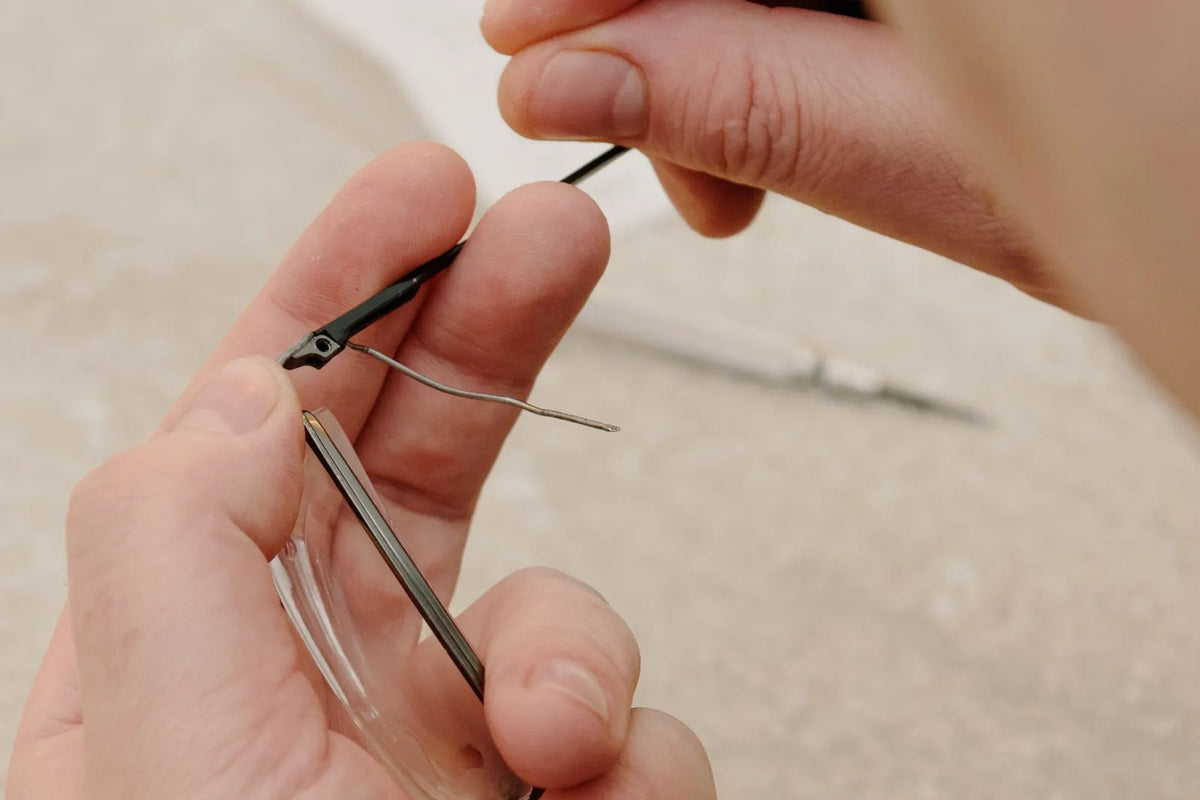
The catch is that a rimless lens does more than correct your vision. In many drill-mount designs, the bridge and temple hardware attach directly through holes in the lens. That means the lens material, the condition of the frame hardware and the way the lens is finished and mounted all matter to the finished pair.
If you are unsure about a particular frame, Lensabl’s public guidance asks for frame photos and a copy of the prescription so the frame can be reviewed before you place the order. That is the safer route if the mount is unusual, the frame has visible damage or you would be especially reluctant to replace it.
Why rimless and drill-mount glasses are different from full-rim frames
A full-rim frame supports the lens around its perimeter. A typical drill-mount frame does not. Instead, small holes or slots in the lens become attachment points for the bridge and temples. Because those attachment points pass through the lens itself, local stress around the holes matters more than it would in a conventional full-rim frame.
What a drill point is
A drill point is the hole or slot cut into a rimless lens so the frame hardware can attach. Depending on the design, the mounting system may use screws, posts or small plastic bushings. The exact hole position has to match the frame hardware so the lenses sit correctly and the finished glasses stay aligned.
Why the lab checks alignment and mounting stress
Technical guidance for drilling polycarbonate rimless lenses emphasizes accurate drill placement, controlled processing and a final stress/alignment inspection. Vision-Ease’s drilling guidance warns that excessive drilling pressure or speed can create damaging heat, and that excess tension in the assembled eyewear may contribute to later fractures.
That is why this is lab work rather than a DIY lens swap. A rimless frame can look simple on the face, but the finished lenses and hardware have to work together without forcing the lens into a stressed position.
What increases breakage risk when rimless glasses are relensed?
There is no useful universal percentage for how likely a rimless lens is to break. Risk depends on the actual frame, lens, mounting system and what happens during processing and later wear. The factors below are the ones worth paying attention to.
| Factor | Why it matters | What you may notice | What the lab evaluates |
|---|---|---|---|
| Frame and hardware condition | A damaged or distorted mounting system can make correct alignment harder and may place unwanted stress on the lens. | Cracked or severely bent frame parts; missing, loose or visibly damaged hardware. | Whether the frame and mount are suitable to reuse and can be aligned correctly. |
| Drilling and hole finish | The drill point is a stress-sensitive area. Heat, subsurface damage or poor finishing can weaken the area around the mount. | Usually not something you can judge accurately at home. | Hole location, drilling quality, finishing and the condition around the mount. |
| Lens material | Different materials behave differently under impact and mounting stress. Lensabl also has material restrictions for rimless orders. | The material of your current lenses may not be obvious. | Which available material fits the prescription, mount and Lensabl’s current lab rules. |
| Lens geometry around the mount | The prescription, lens shape and thickness affect how much material is available around a drill point. | Very thin-looking edges or an unusual lens shape can be a reason to ask before ordering. | Whether the chosen lens geometry leaves an appropriate mount area for that specific job. |
| Assembly tension and alignment | A lens that is forced into position or mounted with excess tension can carry stress after the job is finished. | A frame that already sits twisted or noticeably out of alignment. | Final alignment, hardware fit and signs of excess stress after assembly. |
| Wear, impact and edge condition | Scratches, edge damage and later impacts can reduce the strength of a finished lens. | Deep scratches, chips or damage near the lens edge or mount. | Whether the new lenses pass the lab’s finishing and quality checks before return. |
Drilling, finishing and edge condition
FDA guidance on impact-resistant lenses notes that drilling holes, grinding or surfacing, coatings and the condition of a lens edge can affect impact strength. FDA guidance also makes an important distinction: an impact-resistant lens is not the same as an unbreakable or shatterproof lens.
For a rimless frame, that matters because the mounting holes are part of the finished lens. Good material alone cannot compensate for poor processing, damaged edges or a mount that puts the lens under avoidable stress.
Mounting tension and hardware condition
The hardware is only part of the picture; how it sits against the finished lens matters too. Vision-Ease guidance for polycarbonate drill mounts calls for minimizing excess mounting tension and checking the finished eyewear for stress, position and alignment. A bushing, where a design uses one, is a small sleeve or cushion between the mounting hardware and lens.
If a bridge, temple, post or screw looks damaged, do not try to “fix” the mount by tightening it before mailing the frame. Flag the issue in your frame review so the lab can decide whether the hardware and frame are suitable to reuse.
Which lens materials work for rimless glasses?
Material choice can be confusing because a material may be offered generally without being appropriate for every drill-mount prescription and frame. For Lensabl, the clearest public rule is that CR39 and glass are not available for rimless or semi-rimless orders.
| Material | Lensabl public rimless status | What is established | Practical takeaway |
|---|---|---|---|
| CR39 | Not available for rimless/semi-rimless | This is a Lensabl-specific eligibility rule. | Do not select CR39 for a Lensabl rimless order. |
| Glass | Not available for rimless/semi-rimless | This is a Lensabl-specific eligibility rule. | Glass is not offered for these Lensabl orders. |
| Trivex | Offered by Lensabl generally; exact order still depends on the frame/Rx | PPG describes Trivex as impact-resistant, lightweight and especially well suited to rimless/drill-mount and semi-rimless frames. | A strong material to discuss for a drill mount, but not an automatic “best” choice for every prescription. |
| Polycarbonate | Offered by Lensabl generally; exact order still depends on the frame/Rx | It is impact-resistant, and professional guidance covers its use in drilled rimless mounts. Processing and assembly quality still matter. | A common rimless candidate, but impact-resistant does not mean unbreakable. |
| 1.67 / 1.74 high-index | Lensabl offers high-index lenses generally; no universal drill-mount rule is stated on the public eligibility page | Higher index can reduce thickness for stronger prescriptions, but material selection and mount geometry have to be evaluated together. | Confirm the exact rimless/high-index combination during the frame review rather than assuming it will qualify. |
Trivex
PPG, the manufacturer of Trivex material, describes it as impact-resistant and lightweight, and specifically calls it well suited to rimless, drill-mount and semi-rimless frame styles. That makes Trivex a relevant option when the prescription and frame allow it. It still should not be described as crack-proof, shatterproof or automatically safest for every rimless job.
Polycarbonate
Polycarbonate is another impact-resistant lens material commonly associated with demanding eyewear applications. Professional drilling guidance specifically covers polycarbonate rimless mounts, showing how it can be processed for drilled eyewear. The same guidance also shows why technique matters: heat, hole finish, tension and final alignment can affect the finished lens.
What about high-index lenses?
Lensabl currently offers 1.67 and 1.74 high-index lenses for stronger prescriptions on its general lens-selection pages. Lensabl’s lens options do not, however, establish a single public rule that says every high-index option can be used with every rimless or drill-mount frame.
If you have a stronger prescription, ask Lensabl to evaluate the frame and prescription together. This avoids treating “high index” as a simple yes-or-no category when the actual mount, lens shape and available geometry also matter.
Does lens shape matter when rimless glasses are relensed?
Yes. In a rimless pair, the lens perimeter is part of the visible design, and the mounting holes have to correspond with the bridge and temple hardware. Changing lens shape or size can therefore change both the look of the glasses and the geometry around the drill points.
Prescription also affects lens geometry. A stronger prescription may create a different center or edge thickness than the old lens, so the lab has to consider the prescription, material, shape and mount together rather than treating the old outline as the only variable.
If your goal is to keep the same frame but intentionally change the lens shape, confirm that request before ordering. Lensabl’s public eligibility pages do not promise that any existing rimless hardware can be paired with an arbitrary new lens shape.
A quick rimless-frame check before you send it in
A home check can help you decide whether to ask for a frame review, but it cannot guarantee that the frame will pass lab inspection.
Look at the frame hardware. If the bridge, temples, posts or screws appear damaged, missing or badly out of alignment, send photos before ordering.
Check the frame itself. Lensabl says frames submitted for lens replacement should be in good condition, not cracked or severely bent.
Note damage near the lens mounts. If an old lens is cracked, chipped or damaged around a drill point, photograph it clearly rather than trying to repair or tighten the mount yourself.
Flag anything unusual. Vintage, delicate, uncommon or hard-to-identify drill mounts deserve a pre-order frame check even if they look usable.
Have your prescription ready. Lensabl’s eligibility guidance asks unsure customers to provide frame photos along with a copy of the prescription for review.
Ask before changing the shape. A requested shape or size change can affect how the existing hardware lines up with the new lens.
What happens next if your rimless frame looks suitable?
Check the frame and choose your replacement lenses. Start with Lensabl Lens Replacement and use the eligibility review first if the mount is unusual or damaged.
Place the order with the correct prescription information. Material availability can depend on the prescription and frame, so use the configurator and frame review to guide the final selection.
Pack and send the glasses using the current instructions. Lensabl’s packing guide says to cushion the glasses so they do not rattle in the box and not to include cases or accessories.
Once the frame reaches the lab, the practical question is no longer simply “is this rimless?” It is whether this specific frame, mount, prescription and lens choice can be finished and assembled correctly.
Rimless lens replacement FAQs
Can a cracked rimless lens be replaced while keeping the frame?
A cracked lens does not by itself tell you whether the frame can be reused. The frame and mounting hardware still have to be suitable for lens replacement. If the crack is near a drill point, or the bridge or temple hardware also looks damaged, send clear photos for a frame review before ordering.
Is Trivex or polycarbonate better for rimless glasses?
There is no single material that is automatically best for every rimless prescription. PPG specifically describes Trivex as well suited to drill-mount eyewear, while polycarbonate is also an impact-resistant material with established rimless drilling guidance. The better choice depends on the prescription, frame, lens geometry and Lensabl’s current ordering rules.
Can high-index lenses be used in rimless glasses?
High-index lenses may be an option, but Lensabl’s public rimless eligibility guidance does not give a universal 1.67 or 1.74 rule for drill mounts. If your prescription points you toward high index, have Lensabl confirm the exact frame-and-lens combination before you rely on it.
Can I change the lens shape when I relens a rimless frame?
Do not assume so. In rimless eyewear, the lens shape and the drill locations have to work with the existing bridge and temple hardware. If you want a different outline or size, ask Lensabl to confirm the request for your frame before ordering.
Are impact-resistant rimless lenses unbreakable?
No. FDA guidance explicitly distinguishes impact resistance from being shatterproof. Material choice matters, but so do processing, mounting stress, wear and later impact.
Sources
The technical statements in this article rely on primary regulatory, manufacturer and professional optical-processing sources. Lensabl service and eligibility statements are linked directly to current Lensabl pages in the article.