
Can Wraparound Frames Be Relensed? Prescription, Curvature & Distortion Limits
“Wraparound” describes how a frame curves around your face; it does not tell you, by itself, whether a replacement prescription lens will work. The answer depends on the frame construction, your prescription, the lens shape and design, and how the finished lenses will sit in front of your eyes.
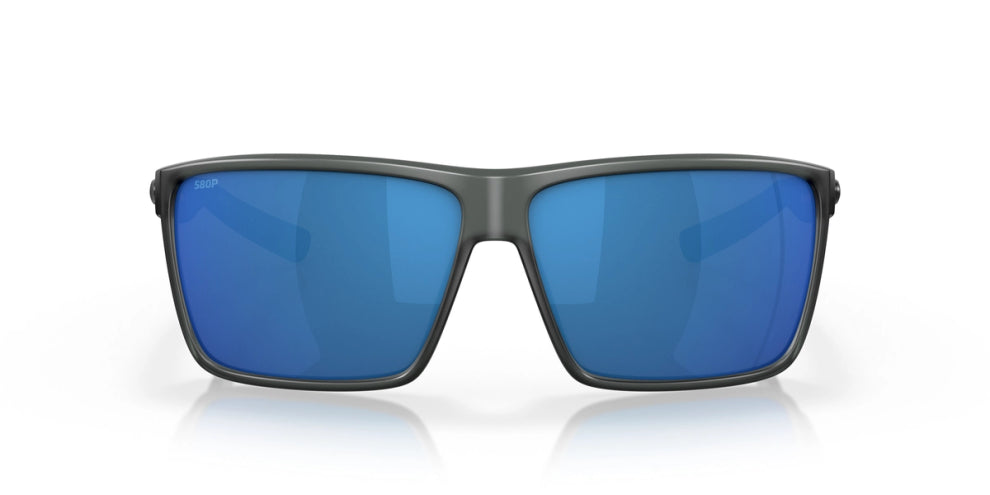
Wraparound Frames Lensabl Can—and Can’t—Relens
Lensabl’s current eligibility guide distinguishes two-lens Sports/Wrap Frames from one-piece shield lenses. That distinction is the fastest first check.
| What you have | Current Lensabl status | What that means |
|---|---|---|
| Two-lens Sports/Wrap Frame | Eligible frame category | Compatibility is still frame- and Rx-specific. |
| CR39 or glass in a Sports/Wrap Frame | Not available for this frame category | Choose from the options Lensabl confirms for your order. |
| Single-piece shield lens | Not eligible | This is Lensabl’s current policy; it is not a universal statement about every lab. |
| Strong or complex prescription | Case-by-case | Lensabl does not publish a single diopter cutoff for all wrap frames. |
| Unsure about your frame | Pre-check before ordering | Send frame photos and a copy or photo of your Rx to Lensabl. |
If you are not sure which category your frame falls into, use Lensabl’s lens replacement eligibility guide before placing an order. The page currently asks customers to send photos of the frame and a copy or photo of the prescription to hello@lensabl.com when eligibility is unclear.
Why Relensing a Wraparound Frame Is Different
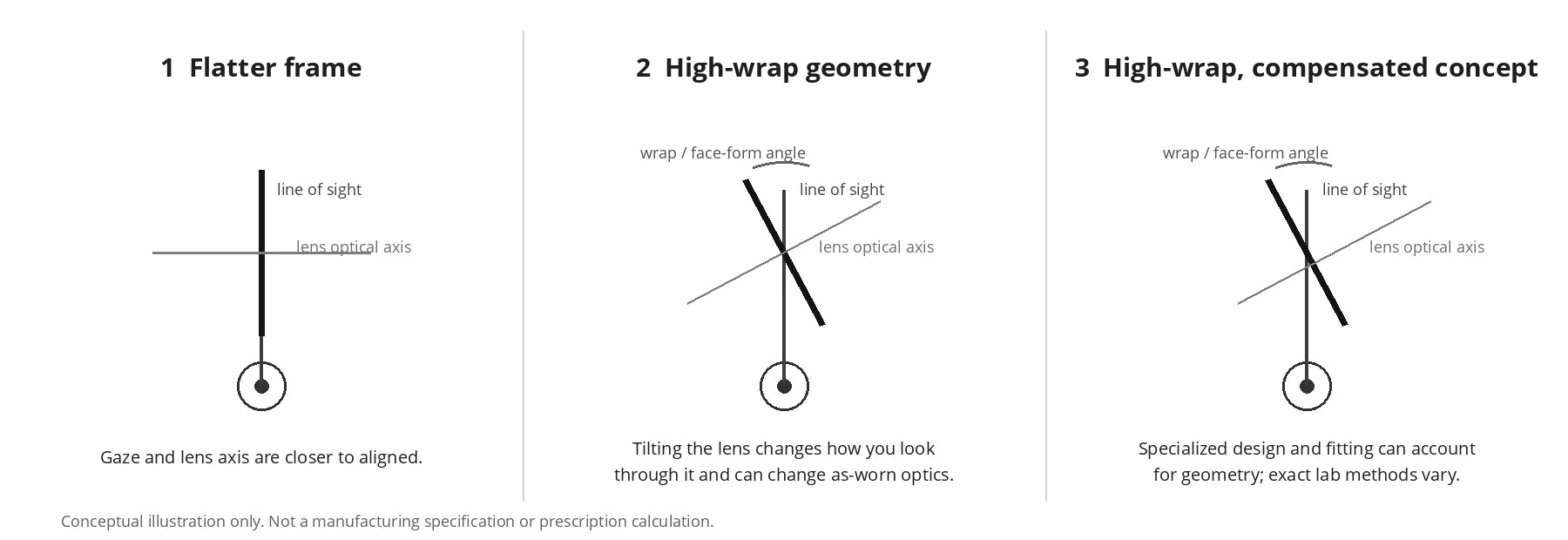
In a flatter frame, each lens sits more nearly straight across the face. A wrap frame turns the lenses inward around the sides of the face. That changes the angle between your line of sight and the lens’s optical axis—the reference direction used when the lens is designed and checked.
Professional opticianry guidance from the National Academy of Opticianry explains that this change in lens position can change effective power as worn and can introduce unwanted prism or astigmatic error if the lens design and centration do not account for the geometry. A lens may measure correctly in a lensmeter while behaving differently once it is mounted and worn at a significant wrap angle.
That is why a wrap job cannot be judged by prescription strength alone. The frame and the finished lens have to work together mechanically and optically.
Wrap Angle vs. Lens Base Curve: Related, but Not the Same
These terms are often mixed together because both relate to curvature in wrap eyewear, but they measure different things. Treating them as interchangeable can lead to bad assumptions about what a frame or prescription can accept.
| Term | What it describes | Why it matters |
|---|---|---|
| Wrap / face-form angle | How far the frame and lenses turn around the face in the horizontal plane. | It changes the angle at which your eyes look through the lenses and therefore affects as-worn optics. |
| Lens base curve | The curvature of a lens surface, commonly described by an optical curve value. | It affects how the lens fits the frame and how the lens design works with the prescription. |
| The relationship | A high-wrap frame may call for a lens shape and design that work with a steeper frame geometry. | The numbers are not interchangeable. An “8-base” lens is not the same thing as an 8-degree wrap angle. |
What Actually Determines the Prescription Limit for a Wrap Frame?
There is not one useful number that answers this. A workable wrap prescription depends on several variables interacting at once.
| Factor | Why it can change what is possible |
|---|---|
| Frame construction and wrap geometry | The frame has to accept removable lenses, and the lens curvature has to fit the eyewire without forcing the frame or leaving a poor mechanical fit. |
| Prescription components | SPH is only part of the prescription. CYL, AXIS, prism and ADD can make a design more demanding, especially once the lenses are worn at an angle. |
| Lens shape and size | A large, deep or strongly curved lens shape can change edge thickness, blank selection, usable optical area and fitting requirements. |
| Lens type and material availability | Single vision, progressive and bifocal designs do not have identical fitting needs. Materials and designs also have availability limits for specific jobs. |
| Position of wear and centration | PD, optical-center or segment placement, vertex distance, pantoscopic tilt and face-form angle can affect how the prescription performs when the frame is worn. |
| Lab and design capability | High-wrap work may require compensated, freeform, aspheric or atoric approaches. The exact method depends on the lab and lens design; Lensabl does not publicly document one universal wrap workflow. |
Is There a “Too Strong” Prescription for Wraparound Frames?
Yes, a particular frame-and-prescription combination can reach a practical limit—but Lensabl does not publish one universal SPH or diopter cutoff that applies to every wrap frame. A number from another brand or lab should not be treated as Lensabl’s rule.
The reason is simple: two prescriptions with the same sphere power can behave differently once cylinder, axis, prism, lens size, wrap geometry and lens design are added to the picture. Higher total power can also make thickness, curvature selection and optical compensation more demanding. That still does not mean a strong prescription automatically rules out a wrap frame.
Best practical rule: if the frame is strongly curved or the prescription is strong or complex, treat eligibility as a frame-specific lab question instead of looking for a universal “maximum Rx” chart.
Can Strong Prescriptions, Astigmatism, Progressives or Bifocals Work?
Strong sphere power
A stronger plus or minus prescription is not an automatic “no.” It does make lens curvature, thickness, frame fit and as-worn optics more important. The lab has to determine whether the chosen frame and available lens design can work together without forcing a poor fit or unacceptable optical compromise.
Astigmatism and prism
Astigmatism is represented by CYL and AXIS on the prescription. In wrap eyewear, horizontal lens tilt can itself create unwanted prism and astigmatic error if the design is not compensated for the wearing position. Prescribed prism adds another optical requirement, so a complex Rx should be evaluated as a whole rather than by SPH alone.
Progressives and bifocals
Lensabl generally offers progressive and bifocal replacement lenses, but that does not mean every progressive or bifocal design is available in every Sports/Wrap Frame. Multifocal lenses depend on accurate fitting placement as well as prescription power. Lensabl’s current prescription-sunglass page says progressive orders require PD and segment-height measurements; wrap compatibility should still be confirmed for the exact frame and prescription.
Why Can Wraparound Prescription Lenses Look or Feel Distorted?
The main reason is that the lenses are not being worn in the same orientation as a flatter pair of glasses. As a wrap frame turns the lenses around your face, your line of sight can pass through them at a different angle. That can change the effective power you experience and can introduce unwanted prism or astigmatic error if the design and fitting do not account for the position.
This is also why “the prescription checks correctly in a lensmeter” and “the glasses feel correct when worn” are not exactly the same question. Centration and position-of-wear variables—such as PD, optical-center placement, vertex distance, pantoscopic tilt and face-form angle—can matter to the result.
Specialized optical designs can compensate for some of these effects. The National Academy of Opticianry describes freeform surfacing, aspheric/atoric design and compensated calculations as tools used in wrap optics. That is a general technical principle, not a claim that Lensabl uses a particular proprietary design or software for every wrap order.
If the finished glasses produce unacceptable visual distortion, do not assume that every problem is simply something you must “get used to.” Contact the lens provider for verification and, when appropriate, the eye-care professional who prescribed your lenses.
What Measurements Matter for a High-Wrap Prescription?
You do not necessarily need to measure all of these yourself. They help explain why a high-wrap job involves more than putting a prescription into a curved lens.
SPH, CYL and AXIS: The core prescription powers and astigmatism orientation.
Prism and ADD, when prescribed: Additional prescription requirements that can change lens design and fitting needs.
PD (pupillary distance): Helps place the optical design in relation to your pupils.
Optical-center or segment height: Vertical placement can matter, especially for multifocal designs.
Vertex distance: The distance from the back of the lens to the eye can change effective power, especially at higher powers.
Pantoscopic tilt: The vertical tilt of the frame affects how the eye looks through the lens.
Wrap / face-form angle: The horizontal angle of the lenses around the face is central to high-wrap optics.
Frame lens shape and size: The finished lens must fit the actual frame geometry as well as the prescription.
Lensabl does not publicly document a single wrap-order measurement workflow for every frame. That does not mean every variable above is collected the same way on every order.
How to Check Your Wrap Frame Before You Order From Lensabl
Confirm that the frame uses two separate lenses. Lensabl currently lists single-piece shield lenses as not eligible.
Check the frame itself for damage. A frame that is cracked, severely bent or otherwise compromised may not be a good candidate for relensing.
Have your current prescription ready, including CYL/AXIS, prism or ADD if those appear on your Rx.
Know the lens type you need: single vision, progressive, bifocal or non-prescription sunglass lenses. General availability does not guarantee compatibility with every wrap frame.
Review Lensabl’s current eligibility page rather than relying on an old forum post or another company’s prescription chart.
If the frame is strongly curved or you are unsure, send clear photos of the frame plus a copy or photo of your prescription to hello@lensabl.com before placing the order.
Once the frame and prescription are confirmed as workable, continue with Lensabl’s lens replacement order.
Wraparound Frame Relensing FAQs
Can any wraparound sunglasses be relensed?
No. Lensabl lists Sports/Wrap Frames as an eligible category, but compatibility is not universal. The frame construction and prescription still matter, and Lensabl lists single-piece shield lenses as not eligible.
Can Lensabl relens one-piece shield sunglasses?
Lensabl’s current eligibility page lists “Shield Lenses (single piece lenses)” as not eligible. That is a Lensabl-specific eligibility rule, not a statement that no optical lab can ever work with a shield design.
Can a high prescription go in a wraparound frame?
Sometimes. Lensabl does not publish one maximum diopter number for all wrap frames. Strong prescriptions depend more on frame geometry, prescription components, lens design/material availability and lab capability, so the exact frame-and-Rx combination should be checked.
Can progressive lenses be used in a wraparound frame?
Potentially. Lensabl offers progressive replacement lenses, but it does not publicly guarantee that every progressive prescription works in every Sports/Wrap Frame. Multifocals also depend on fitting measurements, so compatibility should be confirmed for the specific frame.
Why do wraparound prescription lenses sometimes look distorted?
A wrap frame changes the angle at which you look through the lenses. If the optical design and centration do not account for that wearing position, you may experience changes in effective power, unwanted prism or astigmatic error.
Is an 8-base lens the same thing as an 8-degree wrap angle?
No. Base curve describes lens-surface curvature, while wrap or face-form angle describes how the frame and lenses turn around the face. They are related design variables, but the numbers do not represent the same measurement.
What should I send Lensabl to check my frame?
Lensabl’s eligibility page currently asks for photos of the frame plus a photo or copy of your prescription when you are unsure whether the frame qualifies. Send those details to hello@lensabl.com before ordering.
The Practical Next Step
If your wrap frame uses two separate lenses, the next question is not “What is the universal prescription limit?” It is “Can this frame, this prescription and the available lens design work together?” Lensabl’s public rules are the first check; the pre-check covers combinations that need a closer look.
If your frame appears eligible, start your lens replacement order. If you are still unsure, check frame eligibility first and send the requested photos and prescription before ordering.
Sources
Lensabl — Lens Replacement Eligibility — current Sports/Wrap Frame, material and shield-lens eligibility rules; pre-check instructions.
Lensabl — Lens Replacement — current lens-replacement service and general single-vision, progressive and bifocal availability.
Lensabl — Prescription Sunglass Lenses — current sunglass-lens options and progressive measurement information.
National Academy of Opticianry — Vertex Distance, Effective Power and Compensated Power / Tilt / Wrap — technical background on wrap angle, effective power, prism, astigmatic error, position of wear and compensated design.
Technical scope note: Technical discussion above explains general optical principles and should not be read as a description of Lensabl’s proprietary lab software, compensated-lens workflow or a universal prescription-acceptance range.